


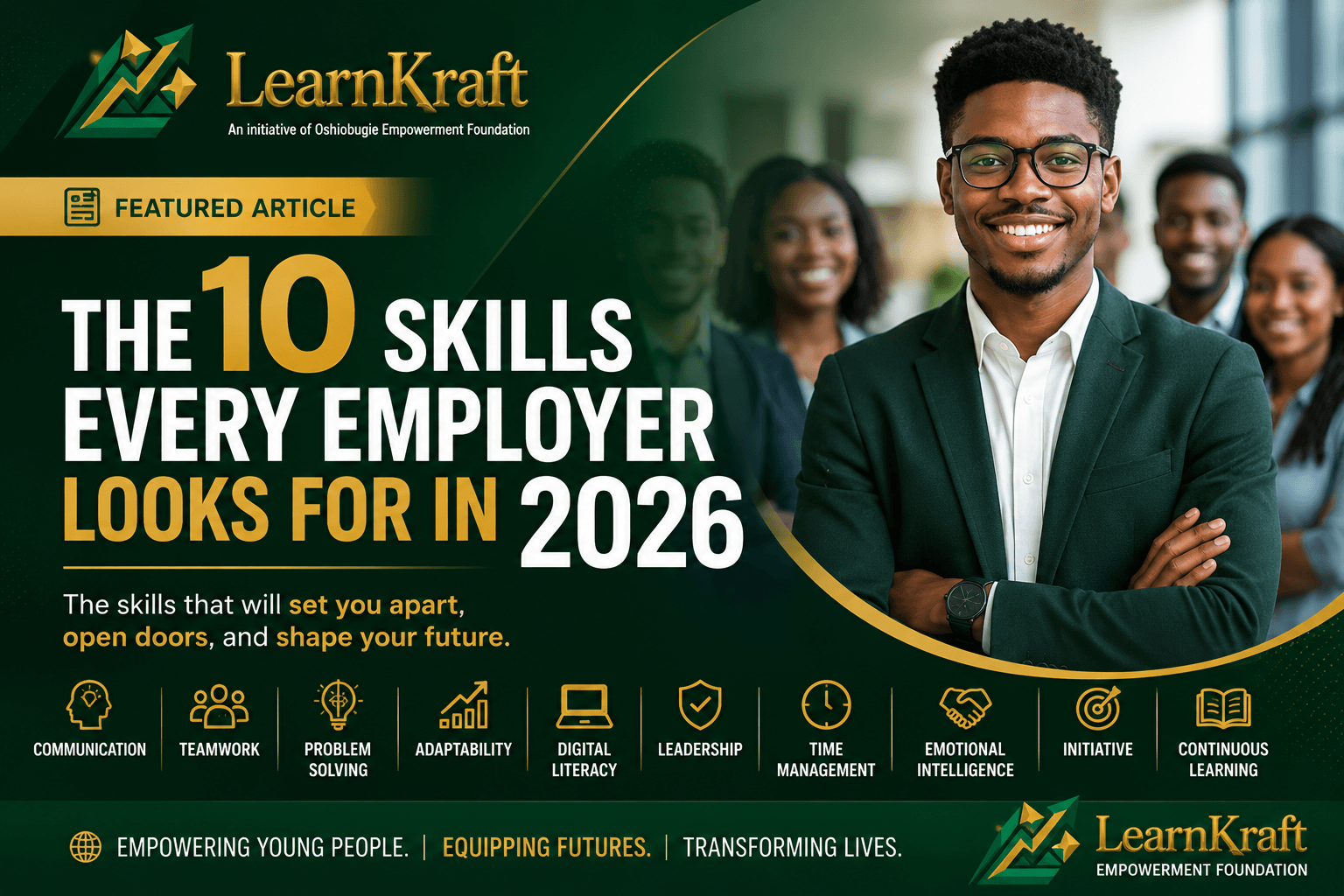
10 Essential Skills Every Young Professional Should Develop in 2026
The world of work is changing faster than ever before.
New technologies, evolving industries, remote work, artificial intelligence, and global competition have transformed what employers expect from today's workforce. While academic qualifications remain valuable, they are no longer the only measure of career potential.
Increasingly, employers are looking for individuals who can communicate effectively, solve problems, adapt to change, work collaboratively, and continue learning throughout their careers.
For young people entering the workforce in 2026, success depends on developing a balanced combination of technical expertise, interpersonal abilities, and personal discipline.
At LearnKraft Empowerment Foundation, we believe that preparing young people for meaningful careers begins long before they submit their first job application. Career readiness is about building the knowledge, skills, confidence, and mindset needed to succeed in a rapidly changing world.
Here are ten essential skills every young professional should focus on developing.
1. Communication Skills
Strong communication remains one of the most valuable professional skills across every industry.
Communication is more than speaking fluently. It includes listening carefully, presenting ideas clearly, writing professionally, asking thoughtful questions, and adapting your message to different audiences.
Whether you are participating in interviews, collaborating with colleagues, writing emails, or presenting projects, effective communication builds trust and demonstrates professionalism.
Ways to improve:
Practice public speaking
Improve your writing skills
Learn active listening
Participate in discussions
Ask for constructive feedback
Professionals who communicate well often become stronger leaders and better team members.
2. Digital Literacy
Digital competence has become essential regardless of career field.
Today's professionals are expected to confidently use digital tools for communication, collaboration, research, productivity, and problem-solving.
Basic digital literacy now includes:
Cloud collaboration tools
Office productivity software
Online research
Video conferencing
Digital file management
Cybersecurity awareness
Responsible AI usage
Being comfortable with technology allows young professionals to adapt quickly as workplaces continue to evolve.
3. Critical Thinking and Problem Solving
Every organization values employees who can think independently.
Rather than waiting for instructions, successful professionals identify challenges, evaluate possible solutions, and make informed decisions.
Critical thinking involves:
Analyzing information objectively
Asking meaningful questions
Evaluating evidence
Considering multiple perspectives
Making logical decisions
Problem-solving is a skill that grows stronger with practice and experience.
4. Adaptability
The only constant in today's workplace is change.
Industries evolve, technology advances, job roles shift, and new opportunities emerge unexpectedly.
Young professionals who embrace change instead of resisting it are often better positioned for long-term success.
Adaptability means:
Learning new technologies
Accepting feedback
Remaining open-minded
Managing uncertainty
Adjusting to different work environments
Employers increasingly value individuals who remain flexible and resilient during periods of change.
5. Emotional Intelligence
Professional success is not determined by intelligence alone.
Emotional intelligence enables individuals to understand their emotions while recognizing and responding appropriately to the emotions of others.
It includes:
Self-awareness
Self-control
Empathy
Relationship management
Conflict resolution
People with high emotional intelligence often build stronger professional relationships, lead teams more effectively, and navigate workplace challenges with greater confidence.
6. Time Management
Everyone has twenty-four hours each day.
The difference lies in how effectively those hours are used.
Time management allows professionals to:
Meet deadlines
Prioritize important tasks
Reduce stress
Improve productivity
Maintain work-life balance
Simple habits such as planning your day, setting priorities, and avoiding distractions can significantly improve productivity over time.
7. Collaboration and Teamwork
Modern workplaces depend on collaboration.
Projects often involve individuals with different backgrounds, expertise, and perspectives working toward shared goals.
Strong teamwork requires:
Respect
Reliability
Clear communication
Accountability
Cooperation
Employers value professionals who contribute positively to team success while supporting the growth of others.
8. Continuous Learning
Learning should never stop after graduation.
Technology, industries, and professional expectations continue evolving throughout a person's career.
Successful professionals regularly:
Read industry publications
Complete online courses
Attend workshops
Learn new software
Develop additional certifications
Seek mentorship
A commitment to lifelong learning keeps skills relevant and opens new career opportunities.
9. Leadership
Leadership is not limited to managers or executives.
Young professionals demonstrate leadership whenever they:
Take initiative
Solve problems
Support colleagues
Accept responsibility
Inspire others through positive actions
Leadership begins with personal accountability.
Organizations consistently seek employees who demonstrate ownership and contribute beyond their assigned responsibilities.
10. Resilience and Growth Mindset
Every career includes setbacks.
Job applications may be rejected.
Projects may fail.
Plans may change.
What separates successful professionals is not the absence of challenges but their response to those challenges.
A growth mindset encourages individuals to view obstacles as opportunities for learning rather than permanent failures.
Resilient professionals continue improving, adapting, and moving forward despite temporary setbacks.
Why These Skills Matter More Than Ever
Technical knowledge may help someone secure an interview.
These essential professional skills often determine long-term career success.
As automation continues transforming industries, the abilities that machines cannot easily replicate—communication, creativity, empathy, leadership, collaboration, and critical thinking—become increasingly valuable.
Young people who intentionally develop these skills position themselves for greater opportunities in both local and international workplaces.
Career readiness is no longer about having all the answers.
It is about becoming someone who can learn, adapt, contribute, and grow throughout every stage of their professional journey.
How LearnKraft Empowerment Foundation Supports Career Readiness
At LearnKraft Empowerment Foundation, we believe every young person deserves access to opportunities that help them realize their full potential.
Through our career readiness initiatives, mentorship programs, educational support, language learning opportunities, leadership development, and community empowerment projects, we equip young people with practical skills that prepare them for success in an increasingly competitive world.
Our mission goes beyond helping individuals find employment.
We aim to empower young people with the confidence, knowledge, and lifelong learning mindset needed to build meaningful careers, contribute positively to their communities, and create lasting impact.
Final Thoughts
The future belongs to those who prepare for it.
Academic qualifications remain important, but employers increasingly seek professionals who combine knowledge with adaptability, emotional intelligence, communication, digital competence, and continuous learning.
Developing these ten essential skills will not happen overnight. It requires consistency, curiosity, and a willingness to keep improving.
Every new skill learned today becomes an investment in tomorrow's opportunities.
Whether you are still in school, recently graduated, or taking the first steps in your career, there has never been a better time to begin developing the skills that will shape your future.
Preparation today creates opportunity tomorrow.
Frequently Asked Questions
What are the most important skills employers look for in 2026?
Employers increasingly value communication, digital literacy, critical thinking, adaptability, teamwork, leadership, emotional intelligence, resilience, time management, and a commitment to continuous learning.
Why are soft skills important?
Soft skills help individuals collaborate effectively, solve problems, communicate clearly, and adapt to workplace challenges. These abilities complement technical knowledge and improve long-term career success.
How can young professionals improve their employability?
Young professionals can improve employability by developing practical workplace skills, gaining relevant experience, seeking mentorship, pursuing continuous learning, building digital competence, and maintaining a growth mindset.
What is career readiness?
Career readiness is the process of developing the knowledge, skills, attitudes, and professional behaviors needed to successfully transition into and thrive within the workplace.
Continue Your Career Development Journey
You may also enjoy reading:
How Young Nigerians Can Build Career Confidence in a Competitive World
Leadership Development for Young People: Why Tomorrow’s Leaders Must Start Growing Today
The Role of Personal Development in Career Success
Why Lifelong Learning Is Essential in Today's Economy
About LearnKraft Empowerment Foundation
LearnKraft Empowerment Foundation is an initiative of Oshiobugie Empowerment Foundation dedicated to empowering young people through education, career readiness, mentorship, language learning, scholarship support, community outreach, and responsible pathways to global opportunities. By equipping individuals with practical skills and lifelong learning opportunities, LearnKraft helps build confident, capable, and purpose-driven leaders for the future.